
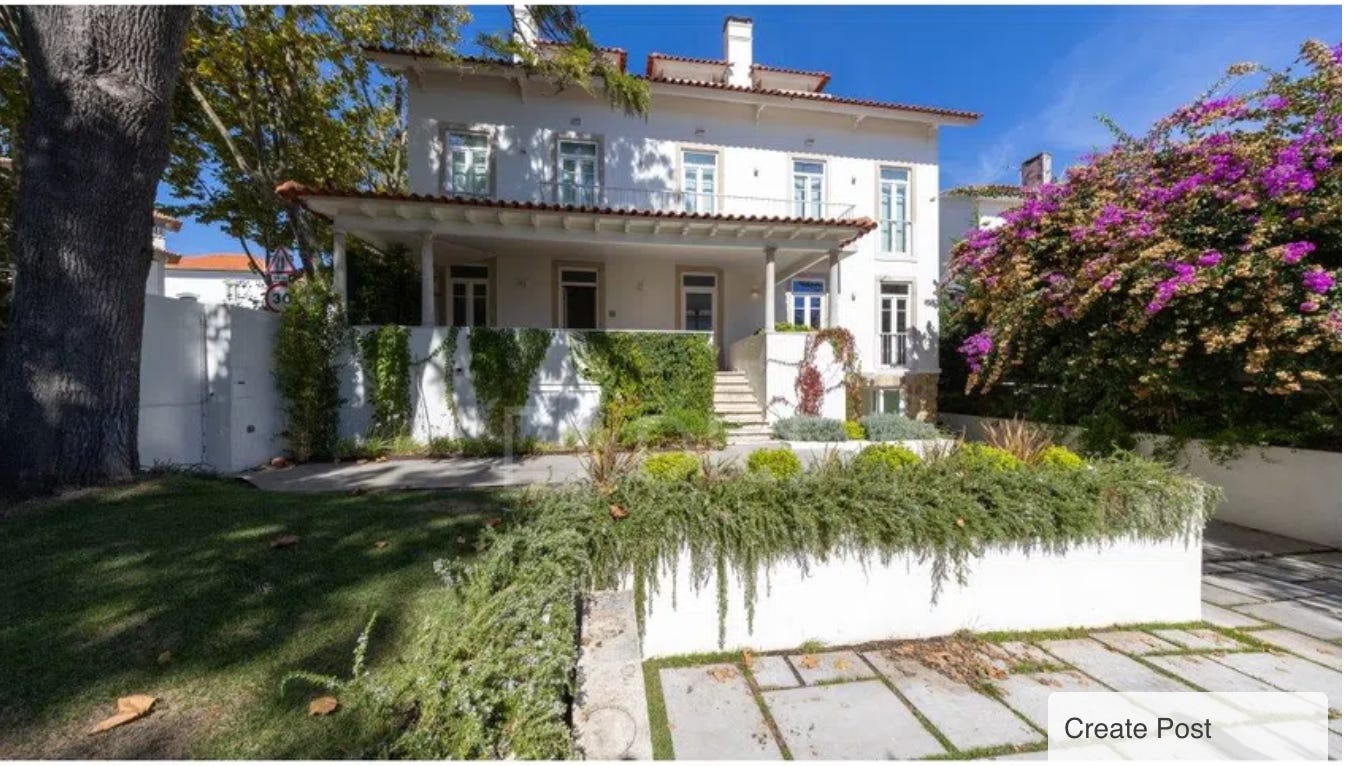
It’s been two months since my husband and I and our two dogs moved permanently to Portugal and everyone is asking how it’s going. The answer is … very well indeed. We feel like this is “home” now and while we miss our friends from the old country1 a lot, we are enjoying our new status as recent immigrants to this beautiful country.
It’s not perfect of course. No country is.
The thing I like the best is that I find my nervous system is no longer on high alert all the time. Which means I can finally relax enough to be truly ‘retired’, a status that has described me for 2 years but wasn’t (much) reflected in my day-to-day life. I spend a lot of time now doing things I enjoy which includes sitting out on my veranda with the dogs, reading, catching up on video. When I’m out and about, I find myself exploring art museums both here in Cascais2 and in Belem3, a neighborhood which is considered Lisbon’s culture center and located only 30 minutes from us. I recently joined Democrats Abroad Portugal (more on that in a latter post) and find that between that, pilates, and language study that I am surprisingly busy.
The recent blackout affected us - of course. How could it not? We live in a large-ish condominium complex with a pool and since the kids were sent home from school, everyone congregated there. About an hour into the blackout all cell service ceased … which left me feeling profoundly untethered but didn’t seem to phase the Portuguese. At all.
The initial rumor was that all of Europe was “dark” and speculation was rampant at the pool and later at the dog park that this was Putin’s work and perhaps the beginning of WWIII.
While Lisbon was a mess (due to gridlock), here in Cascais people remained chill. Everyone clustered at the pool in our complex, enjoying the good weather and an unexpected day off from school and jobs. Which is very Portuguese I’m told. To make the most of the moment. (It turns out that the blackout did not effect all of Europe, just Portugal, Spain, and parts of France. The cause is still unknown at this point. My money remains on terrorism.)
The Portuguese people are lovely and everyone seems very welcoming. There are both language and cultural barriers, of course. Most people we meet speak some English; the younger people all learn English in school. I’m told that there are mixed feelings about all the immigrants coming here, particularly those who call themselves “expats” and make no effort to assimilate. We are committed to assimilating ourselves and are slowly progressing with our language study … not an easy thing. At times, the language feels like something made up by children to keep adults from understanding what they are saying Lots of extra vowels and syllables inserted every which way4.
We appreciate how privileged we are to be able to escape the harrowing mess that is the United States. Immigrating to a country where you don’t know the language and know next to no one is not an easy thing. If you too are looking for an escape plan, Portugal could be an option for you. The first thing you need to do is research visas and find one that fits your needs.
Many people are motivated to come to Portugal for a more affordable retirement. You should know that what you will spend on the ground here is heavily dependent on where you chose to live. We chose Cascais which is a breathtakingly beautiful beach town with great access to Lisbon (45 minutes by train). The down side of Cascais is that it is a costly place to live and certain areas - particularly Centro or the center of town - can get overrun by tourists who come in by train and by bus.
We live about 3 km from Centro which meant that we need a car to get around. In terms of housing, our condo in the U.S. was 2000 square feet or 185 square meters. We did not expect to live in 2000 square feet here; the average apartment in Europe is 1000 square feet or 100 square meters. So set your expectations accordingly. As it turned out, we landed in a rental apartment that is 1500 square feet or 139 square meters. When we look at properties to buy, we may have to look outside of Cascais to find something suitable. We have a bit of a team on the ground helping us with housekeeping, dog walking, paperwork and that makes a big difference in the quality of our lives. Between housing and this help, it means our retirement isn’t “cheap”; so much so that my husband Rich has decided to keep working until the end of the year.
1 This is what we are calling the U.S. these days.
2 Located about 30 km from Lisbon, Cascais started out as a little fishing village and has evolved into an upscale city of 250,000 that has been compared to La Jolla, California.
3 Belem is a neighborhood of Lisbon and considered its cultural center.
4 In point of fact, this is more or less how the Portuguese language evolved. The goal was to make it hard for the Spanish - who ruled Portugal as a colony until 1640 - to understand what the locals were planning as they fought and won their independence from Spain.